Once again this year, Lloyd Johnson had organized a demonstration of traditional blacksmithing techniques over a later April weekend at Upper Canada Village in Morrisburg Ontario. This event typically draws about 30 observers, and one of the bonuses is that it's location to the far east of Ontario means a number of blacksmiths from the Montreal region of Quebec also attend. For the 2026 edition, the featured demonstrator was Alex Hinman from Colonial Williamsburg, Virginia. Colonial Willamsburg (CW) is the largest living history site in the USA, which focuses strongly on the American Revolution of 1776. In this the background cultural set, objects, and interpretive presentations are very clearly American Colonial. Alex is one of the principle blacksmiths at the site's re-created Anderson Blacksmith Shop, having come up through the apprenticeship program at CW. The type of work most normally seen in the Anderson shop is production of functional reproductions of more common domestic items as would have been in that shop historically. Work involves coal fires with bellows air, and extensive employing of sledge hammer strikers. The shop is equipped with one forge most typically used for public demonstration type work, with two other forges assigned to more exacting object creation.
Please remember that what follows are my own perceptions and (failing!) memory of what I personally observed. There may very well be errors in these descriptions! Many of the detailed expansions given here were aspects Alex himself provided in discussions.
Alex's physical demonstration centred on the production of three common garden tool objects, well documented in historic catalogues and with physical artifacts. These were a 'Plantation' Hoe, a socketed 5 tine Rake, and a Line Reel.
Importantly, these replicas were all forged from wrought iron, the effective working of this material becoming one of the most significant part of the demonstrations. An important observation for those not familiar with antique wrought iron – it works over a wider range of temperatures than normal with mild steel. Rather than the typical 'bright orange' effective for modern steel, iron needs to be started hotter, often up to the welding temperature. This difference in correct working temperatures means that the time required for the heating cycle usually increased. It is not unusual for cracks to develop along along the encased slag filaments, and the quality of the material certainly varies piece by piece (and sometimes within the same bar).
He would start his demonstration with illustrating simple (?) nail making, this using 1/4 square mild steel. At CW this is actually the standard demonstration object on the public presentation forge, normally carried out by the newest apprentices. (Because of the massive visitor load at CW, the conversation is provided by a second interpreter.) Along with the importance of nail production to the growing Colonies (especially after cutting links with England) Alex pointed out that this was a good light weight task to warm up with physically. This section would include a discussion of the details of the nail making header he used, and various potential construction methods for these tools. One significant detail is that the header used has a slightly domed top. This feature makes it easier for hammer blows to spread the metal towards the edges of the wide head. The square hole on this tool was punched from the bottom upwards, so the smallest diameter was at the top side in use. (This reversed from the shape of much earlier historic heading tools I was familiar with.) During this, in light of questions and further explanations, Alex started to reveal a depth of research and wide knowledge beyond the technical, into the implications of even something as seemingly simple as nails in that Colonial American context. An example he gave was that the standard for a trained, full time, Colonial nail maker was converting 100 lbs of prepared nail rod into 97 lbs of nails, an expectation of only 3% loss in the working.

In the first of his main demonstrations, the Plantation Hoe, Alex would start from a longer piece than required of 2 x 5/8 inch, about 8 inches in total would be used. The first step here was notching and necking in back from the end of the bar, the part that would eventually be formed into the socket.
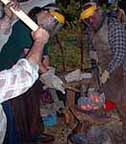
It was during that work that Alex introduced us all to the 'Williamsburg method' of calling a striker to task at hand. Two ringing taps on the horn was the signal. Alex explained that the ringing sound carries though the busy multi-forge Anderson workshop, despite the observing crowds. Unlike most of us watching, working with strikers is standard there (where many of us work alone, or employing powered hammers or presses). Taking turns at various times as strikers were Josh Koss (seen with Alex below), Megan Carter, and Piper Yorke. (The 'who's up first' confusion was a source of amusement to those watching – but themselves not bold enough to step up.)

The very rough steps of forging this object were :
Once notched, the end of the rectangular bar was drawn down (largely on the base of the horn) into roughly 1 x 1 inch square by 4 inches long.
The part of this portion of bar closest to the original notch was then spread at 90 degrees to the line of the source bar. This would form the eventual eye of the hoe. As the material was thinned, it was pushed to one side, so there was a straight line down from the wider source bar towards the end.
The nub of material remaining at the very end was then also flattened, but this in the the same plane as the starting source bar. This would form the tab that would be welded back on to what would be the underside of the final hoe.
The tab was forge welded in place.
Then the eye is correctly contoured using a bick and suitable mandrils into a swage block. The widest part of the conical eye is to the bottom side of the hoe. (This allows a simple friction fit over a natural branch handle, thus requiring minimal working of the wood used.)
At this point the hoe is cut at the eventual blade end from the parent bar. (If my drawing is correct?)
A V shape, wide side roughly the same width as the eye, and point towards the blade end, is fullered in. This will create the central re-enforcing rib.
Now using cross peen strokes the blade section is thinned and spread in several directions : backwards towards the eye to create the top corners, sideways to create the width of the blade, forwards to thin towards the cutting edge.

My own rough notes on the working methods

The piece was roughly finished by pulling the blade to the desired tapering thickness, then using a flatter (again via a striker) to smooth that surface The hoe was completed by drawing a short bevel for the working edge.
With a question about use of a welded 'steeled' edge, the deeper topic of plain iron versus steeled and hardened edges, and how that related to Colonial economics, was discussed.
 |
| Completed (rough forged) hoe - Canadian nickle for scale |
The next demonstration project was the production of a five tine and socketed rake. All the elements were created from the same 1/4 x 3/4 inch stock bar. The first part of this process was separately making the three teeth that would be fitted into the main body bar (the last two of the five would be drawn from the ends of the bar). It was as these teeth were formed that Alex exhibited a level of control that was as certain as it was subtle.

- Working off the end of a longer piece of rectangular stock, the first step was to shoulder in near the end of the bar. This was done by pinching the bar between the back radius edge of the anvil and the cross pean, rather than using a pinch shouldering tool. If you have done this method, the matching of stokes with the cross peen needs to be exact – which Alex performed cleanly and quickly each time.
- The nub at the end of the bar was drawn out to a short square shaft, keeping the original thickness of the bar. This would form the tendon for eventual joining of the completed tooth to the bar.
- The shoulder was then squared up by forcing the bar downwards into a punch plate tool.
- A short section of the bar was then cut off, after the length measured via a caliper. (This would allow Alex to have all his starting pieces at the same length for the remaining teeth.) It was pointed out that the cut should be to roughly the same half way depth into the bar from both sides. This collapses the wrought iron grain equally.
- The short piece was then drawn to a point, again maintaining the starting thickness (so collapsing the width only). This work was done primarily over the base of the horn, again to speed the drawing process.
- The last step was to gently curve the completed tooth.
The next teeth would be formed the same way. Alex would check the distance of the separating cut via the set caliper each time. As the next teeth were formed, again the high level of control was illustrated, as each of the next two teeth would be virtually identical to the first. The only comparison I saw Alex make to the first was confirming the curvatures matched as completed.
- (As I remember?) The next step was to pull out the two ends of the main bar into similarly sized and shaped teeth. These would point upwards towards the same edge of the long bar on either end, again formed to match the contours of the earlier teeth. At this stage these are left in the same plane as the flat of the bar. The end teeth are then measured against the others, and the length marked to indicate where eventually these would be folded over.
- One of the separate teeth would eventually be fixed to the centre of the rake bar. The remaining two then will be placed half way between centre and the later end tooth fold. The 1 / 4 point was marked, and square holes punched at those positions. These would be drifted open to match the size of the square tooth shank. One of the reasons to drift open a smaller hole was to distort the iron grain around the hole, rather than cutting the fibres. The swelling from this process would be reduced by hammering down on the bar edge at the hole, with the drift in place to prevent the hole from collapsing.
The next part of the process was to create the separate conical socket for the rake handle. The end of the same stock bar was both flattened and spread (cross peen work) into a thin conical shape. It was during this process that Alex would encounter a problem so familiar to anyone working with wrought iron, fractures when working the end portion of a bar especially with aggressive flattening. Often these fractures make cracks with diagonal cross sections, so an attempt at welding from one edge downwards just ends up making further splitting. An excellent solution to this was demonstrated (see the illustration) :
intentionally forcing the edges downwards, causing the splits to open up slightly and the diagonal edges to slide over each other
generously fluxing the splits, bringing to a welding heat
quickly welding the overlapping splits flat, (hopefully) resealing these cracks

There was a wider discussion from a question : “What would they have been using for flux.” Alex pointed out that borax, used by modern blacksmiths, was also available and widely used in Colonial America. This would have been imported, through England, with the initial source being Turkey. Mention was made of fine white silica sand, often seen in English historical method. A 'backwoods' substitute also known was grinding up the clay nests of mud dauber wasps (because of the very fine particle size).
Once the desired spread of material was created (as Alex pointed out: ' *3* times the desired *interior* diameter, plus a bit for the overlap when welding - pi is for math class.'), the triangle was peened down into the grooves of the swage block. This form would be completed by again forming into the swage block, now working against suitable pointed drift. Alternatives to this were suggested, including using the front step of the anvil. Alex explained that the Colonial anvils run straight from the table on to the horn however.
At this point the cone was cut from the stock bar, leaving a short nub that would eventually become the welded joint to the rake bar.
The cone was carefully brought to a welding heat, then quickly pushed over a bic, and the two edges welded to close the shape.
once completed, the nub at the apex of the cone was flattened, thinning towards the edges all around.
Both the centre of the rake and this formed tab were then brought to welding heat. Again, a process taking some care given the differing thickness of materials. Alex then quickly (and seemingly effortlessly) laid up the two separate pieces for the initial weld. This initial tack weld was repeated to ensure the edges were correctly sealed and blended, then the socket slightly adjusted for square and ideal handle angle
Next the two teeth on the ends of the rake bar were bent down to 90 degrees. Each of the three remaining teeth had their posts trimmed to ideal length, then each was held in the post vice. Laying the rake bar over the post, this end was peened down to secure the tooth. Some final adjustment was made to ensure the individual teeth lined up and were square to the bar, and the rake was complete. As finished, the rake was roughly 12 inches wide
It was during the forging of the rake that Alex would point to the usefulness of his 'side clip' tongs. He pointed out (and would frequently show) how this style was actually more versatile than the full box jaw type.

It was during the creation of the socket that I noted another tool related fixture seen in the Upper Canada shop. As mentioned, the curving of the socket was done by forging down into a swage block. The shop is equipped with a stand formed from a number of pieces of 4 x 4 lumber strapped together. The timber is sized so that there is a lower slot in the centre, this slot of a width and depth that allows the block to be positioned vertically placing the scalloped edges at working height. The side pieces stand up so the block can also be held horizontally, with curved L shaped brackets on the corners securing it in place.

The last object demonstrated was a line reel, used in Colonial times to lay out garden rows. The version made was only roughly like the historic illustration below. The construction of the illustration is riveted, where Alex would make the frame of two pieces forge welded together. (I have to fully admit that my description here is less precise, as with my own early packing up and then leaving before completion Sunday, I missed chunks of this demonstration. So the description here not necessarily in the exact forming sequence)

The version made consisted of two main pieces, a rectangular frame with curved sides, mounted to a long central spike. The frame element was formed from 2 lengths of 1/4 x 3/4 x 15" long, and the spike element 20 " of 1/2" round, all again of wrought iron.
The two basically identical L shaped frame pieces were created first :
- The mid point of the flat bar was carefully marked.
- A short tab was flattened on one end.
- One of the sides, from the mid point, was flattened, to about double the original width (so to half the thickness).
- This portion would be given a curve in cross section, by peening into the on hand swage block groove.
- The exact centre of the remaining flat bar side was measured, then a round hole was punched and drifted. Again the swelling of the bar was straightened by leaving the tapered punch in place while hammering down on the edges.
- At the junction between the still straight side and the contoured side, the bar was folded back on to itself and then this seam welded for about an inch.
- Next the contoured side was folded back into the desired L shape, then slightly curved into a bit of a crescent (not flat sided as in the illustration above).
This process was duplicated for the second frame element Then the first corner of the two L shapes forge welded to make a box like form – still left unconnected at one corner.
The next component to create is the central stake :
- First one end of the round rod chosen is drawn out to a long tapered square profile, to a sharp point.
- Using experience to judge what was required for the rough finished length required, the round rod is necked in slightly, once again by careful pinching of the bar over the radius on the far side of the anvil.
- From this point, the bar is drawn down into an even round profile, to a length slightly longer than the distance from top to bottom of the frame. This was checked for easy fit into the two punched holes in the frame.
- Next a small rectangular piece of bar was prepared, roughly 1/4 thick by about 1/2 inch wide, that will form an integral washer that eventually the lower frame will sit against.
- This was cut from the stock bar with slightly slanted cuts, one from each of the two sides. ( / \ )
- This piece was then curved via a groove in the swage block. The prepared central spike element was laid over the resulting U shape, at the place the shift in rod diameter had been formed, then crimped down tightly against the rod. Alex explained the logic of the mirror image diagonal slices, which would ride up over each other as the 'washer' element was welded into place – rather than butt up against each other, creating gaps.
- Welding this washer into place was the next step. Although you had to be paying attention to see this, he started close to the place the two angled ends overlapped, rotating as he welded, again into the groove. Even with light and quick blows, the washer piece would enlarge slightly, but this would just cause the angled ends to slide over, finishing the weld without a gap.
I would miss the final assembly of this object. Alex was discussing the importance of ensuring the various parts of the forming had to be checked for correct fit, shaping and measurement had to be checked and modified if required before the final open corner was welded together to complete the frame element. The very last step would be peening over the very tip of the central rod to hold the two pieces together – but at the same time ensuring free movement of the rotating frame.
One important addition to the demonstrations was the ability to examine a number of artifact samples of all three objects. These were provided by Alex and also drawn from the (infamous?) Lloyd Johnson Study Collection. One of the aspects of aged wrought iron objects is that weathering often exposes the grain lines. These can inform about the forging processes used, especially things like welding folds and if steeled edges were applied. Along with various samples of various individual's current work, these samples were available for inspection and discussion over evening conversations.
Films referenced during demo
From Alex : “Good evening gents, I know I referenced a lot of historic film in my demo and just wanted to share some of the references.”
Albert Craven, blade forger:
Forging surgeon's scissors:
Czechoslovak Nailers:
https://www.youtube.com/watch?v=Nma4R8izg9o
Belgian nailers:
https://www.youtube.com/watch?v=3WNvWmQ_ldE
Patterson's spade mill:
https://www.youtube.com/watch?v=Yu8BGHC7jeA
German file cutters:
https://www.youtube.com/watch?v=JiE3eyMS4Z4
Iranian wire nipper maker:
https://www.youtube.com/watch?v=8LOl0zKcl5s
Pioneer
Axe:
https://www.youtube.com/watch?v=Qr4VTCwEfko
Swedish iron puddling and rolling:
https://www.youtube.com/watch?v=z1RSTrGV0NM
Thanks to Lloyd Johnson for providing the starting stock measurements, and suggesting details on the aspects of working with antique wrought iron.
Alex Hinman provided the reference images from late 1700's agricultural implement catalogues. Other images and drawings by the author.
Darrell Markewitz / the Wareham Forge
This article remains copyrighted – please request specific permission before re-printing.
see : https://www.warehamforge.ca/copy.html
This article was created at the request of Lloyd Johnson. It was submitted for the Summer issue of the Ontario Blacksmith's Association quarterly publication The Iron Trillium (in good time), but never included.




 Posts
Posts